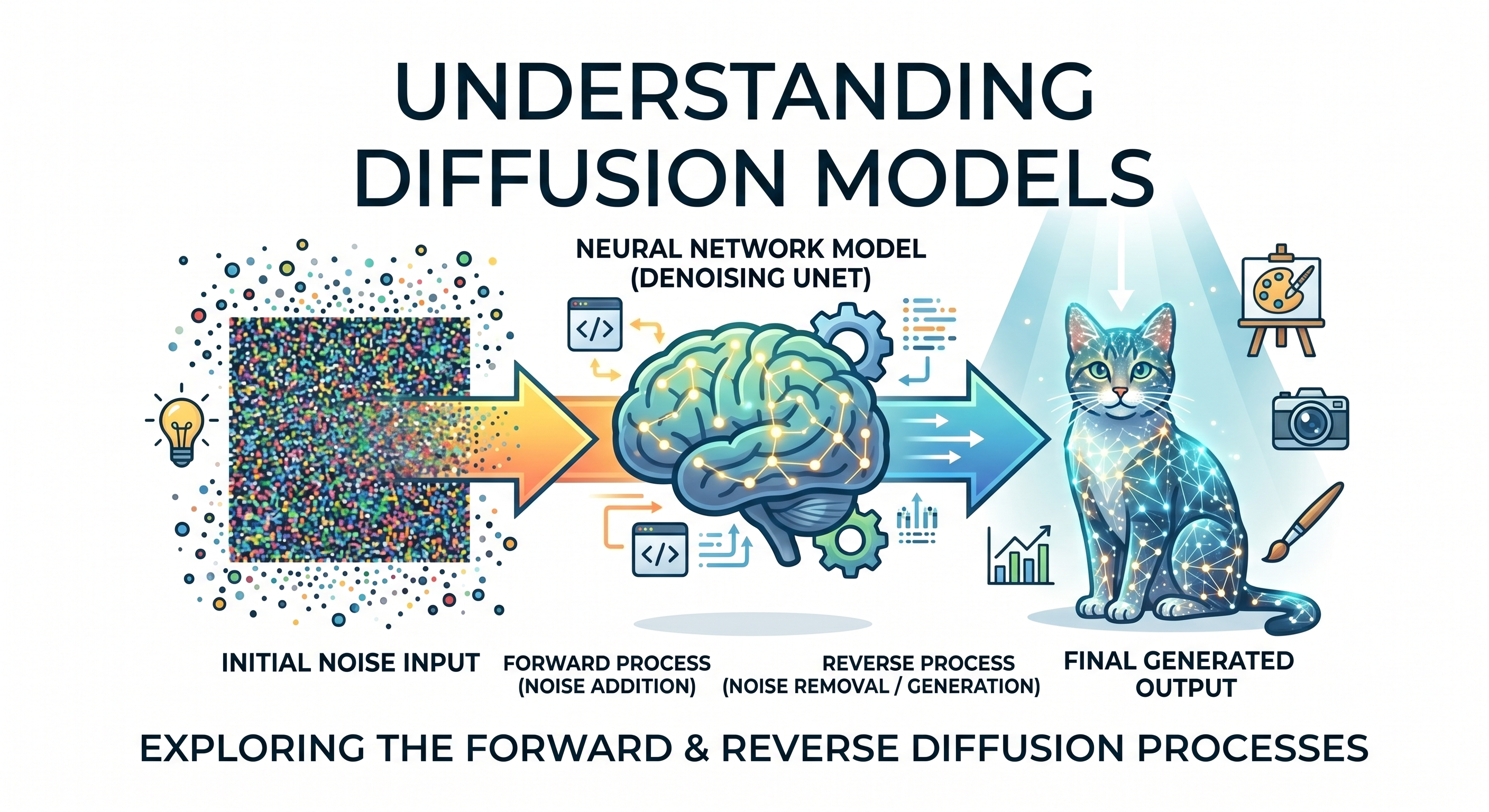
When Stable Diffusion was released in 2022, it sparked a creative revolution. Suddenly, anyone could type a sentence and receive a photorealistic image. Behind the magic lies an elegant and deeply mathematical framework called diffusion models — a class of generative AI that has not only surpassed GANs in image quality but has also been extended to audio, video, and even molecular design. Understanding how they work is essential for any serious deep learning practitioner.
The Core Intuition: Learning to Denoise
Diffusion models are rooted in a surprisingly simple idea from physics: if you gradually add noise to a signal, you eventually destroy it completely. If a model can learn to reverse this process — to remove noise step by step — it can generate realistic data from pure random noise.
Formally, this involves two processes:
- The Forward Process (Noise Addition): A clean training image x₀ is progressively corrupted over T timesteps by adding small amounts of Gaussian noise. After enough steps (typically T=1000), the image becomes indistinguishable from pure noise. This process is fixed — there are no learnable parameters here.
- The Reverse Process (Denoising): A neural network (usually a U-Net) is trained to predict and subtract the noise added at each timestep. Given a noisy image at step t, the model predicts what noise was added, effectively learning the reverse of the forward process. At inference time, we start from pure noise and apply this denoising step T times to generate a new image.
The U-Net: The Heart of the Denoiser
The neural network at the core of a diffusion model is typically a U-Net — an encoder-decoder architecture with skip connections. The encoder progressively downsamples the noisy image into a compressed latent representation, and the decoder upsamples it back to full resolution. Skip connections between matching encoder and decoder layers allow the model to preserve fine-grained spatial details while operating at multiple scales simultaneously. Crucially, the current timestep t is injected into the network (via sinusoidal positional embeddings and cross-attention layers) so the model knows how much noise to expect and remove.
Latent Diffusion Models: Scaling to High Resolution
Running the full diffusion process in pixel space is computationally prohibitive for high-resolution images. Latent Diffusion Models (LDMs), introduced by Stability AI (the research behind Stable Diffusion), solve this with a two-stage approach. First, a Variational Autoencoder (VAE) compresses the image into a compact latent space — typically 8x smaller per dimension. The entire diffusion process then happens in this compressed latent space, which is far cheaper. At the end, the VAE decoder reconstructs the full-resolution image from the denoised latent. This is why Stable Diffusion can generate 512×512 images in seconds rather than minutes.
Text-Conditional Generation with CLIP
To make diffusion models text-controllable, a text encoder — typically CLIP's text transformer — converts the prompt into a sequence of embeddings. These embeddings are fed into the U-Net via cross-attention layers at every level of the decoder, conditioning each denoising step on the semantic content of the text prompt. This is how the model knows that "a red apple on a wooden table" should look different from "a golden apple in a mythical forest." The guidance strength is controlled by Classifier-Free Guidance (CFG), a technique that runs both conditional and unconditional denoising and interpolates between them — higher guidance scale means stricter adherence to the prompt at the cost of diversity.
A Practical Code Example with Diffusers
Hugging Face's diffusers library provides a clean, modular API for working with
state-of-the-art diffusion models. The following example demonstrates text-to-image generation and
image-to-image transformation with Stable Diffusion.
# Working with Stable Diffusion using Hugging Face Diffusers
import torch
from diffusers import StableDiffusionPipeline, StableDiffusionImg2ImgPipeline
from diffusers import DPMSolverMultistepScheduler
from PIL import Image

# ── Text-to-Image Generation ──────────────────────────────────────
MODEL_ID = "stabilityai/stable-diffusion-2-1"

# Use DPM-Solver++ for fast, high-quality sampling (20 steps vs 50)
pipe = StableDiffusionPipeline.from_pretrained(
    MODEL_ID,
    torch_dtype=torch.float16
)
pipe.scheduler = DPMSolverMultistepScheduler.from_config(pipe.scheduler.config)
pipe = pipe.to("cuda")

# Enable memory-efficient attention for lower VRAM usage
pipe.enable_xformers_memory_efficient_attention()

prompt = (
    "A photorealistic portrait of a senior data scientist, "
    "surrounded by glowing neural network visualizations, "
    "dramatic studio lighting, 4k, ultra detailed"
)
negative_prompt = "blurry, cartoon, low quality, deformed, watermark"

image = pipe(
    prompt=prompt,
    negative_prompt=negative_prompt,
    num_inference_steps=20,    # DPM-Solver++ is efficient — 20 steps is enough
    guidance_scale=7.5,        # CFG scale: higher = more prompt-adherent
    width=768,
    height=768,
    generator=torch.Generator("cuda").manual_seed(42)  # Reproducibility
).images[0]

image.save("generated_portrait.png")

# ── Image-to-Image (img2img) ───────────────────────────────────────
img2img_pipe = StableDiffusionImg2ImgPipeline.from_pretrained(
    MODEL_ID,
    torch_dtype=torch.float16
).to("cuda")

init_image = Image.open("sketch.png").convert("RGB").resize((768, 768))

refined = img2img_pipe(
    prompt="A detailed oil painting, warm golden hour lighting, impressionist style",
    image=init_image,
    strength=0.75,     # 0=no change, 1=ignore input image completely
    guidance_scale=8.0,
    num_inference_steps=20
).images[0]

refined.save("refined_painting.png")
print("Images generated successfully.")
Beyond Images: Diffusion Models Everywhere
The success of diffusion in image generation has inspired applications across other modalities. AudioLDM and Stable Audio use diffusion in the mel-spectrogram space to generate music and sound effects from text. Video Diffusion Models extend the architecture with temporal attention to generate coherent video clips. In biology, RFdiffusion from the Baker Lab applies diffusion models to protein structure design, generating novel proteins with desired functions — a potentially revolutionary application for drug discovery.
Conclusion
Diffusion models represent one of the most elegant marriages of mathematics and deep learning. By framing generation as a learned denoising process, they achieve stunning sample quality and diversity that has transformed creative AI. For the AI developer, understanding diffusion is no longer optional — it is fundamental to working with the most powerful and widely-deployed generative systems in production today.
"Creativity in AI, like creativity in nature, often emerges from structured randomness. Diffusion models teach us that beauty can be carved from noise — one careful step at a time." - Ashish Gore
Interested in integrating generative AI into your creative or production workflow? Connect with me through my contact information.