Machine learning in finance often faces two challenges: sensitive data and limited data. Regulatory constraints make it hard to share customer records, and rare events like fraud mean datasets are imbalanced. Synthetic data — artificially generated data that mimics real distributions — offers a potential solution. In this post, I’ll explain the benefits, generation methods, and limitations of using synthetic data in financial ML projects.
What is synthetic data?
Synthetic data is artificially created data that has statistical properties similar to real data but does not expose actual customer records. It can be generated through simulations, generative models, or rule-based systems. For finance, this might include synthetic transactions, account profiles, or credit histories.
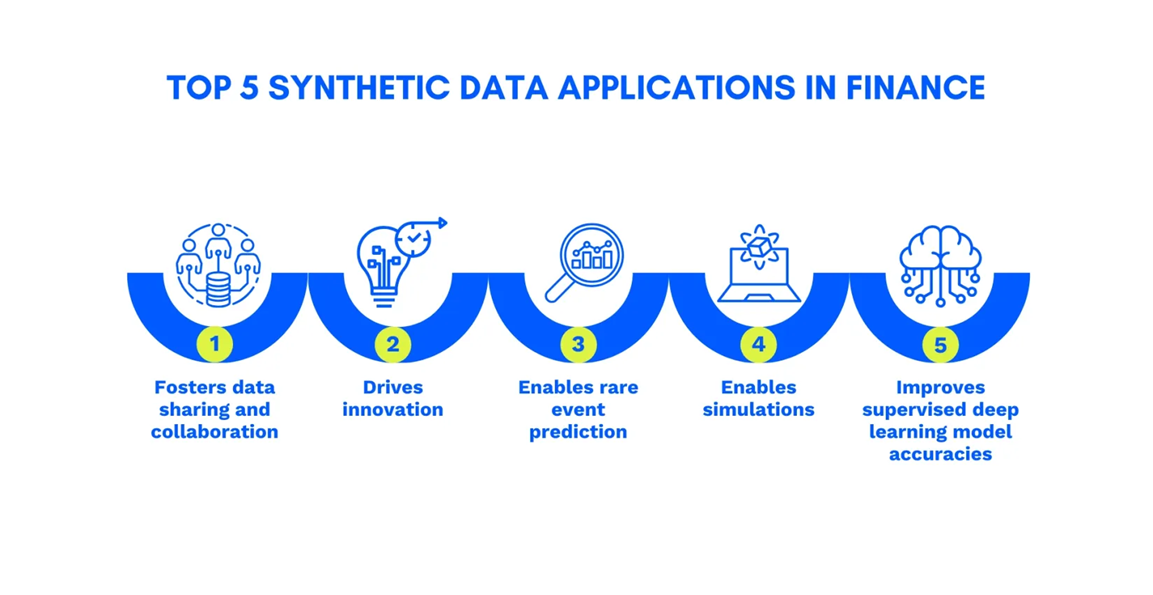
Benefits of synthetic data in finance
- Privacy preservation. Allows model training without exposing sensitive customer data.
- Data augmentation. Balances classes (e.g., adding synthetic fraud cases to handle imbalance).
- Faster prototyping. Teams can build and test models without waiting for access to sensitive production datasets.
- Scenario simulation. Enables stress testing under rare but important conditions (e.g., market crashes, mass defaults).
- Collaboration. Allows data sharing across teams or institutions without violating regulations.
Techniques to generate synthetic data
Rule-based generation
Domain experts define rules to simulate data. For example, transaction amounts can follow log-normal distributions, while fraud cases are injected with anomalies.
Generative models
- GANs (Generative Adversarial Networks). Learn to generate realistic data by training two networks (generator and discriminator) in competition.
- VAEs (Variational Autoencoders). Learn a latent distribution and sample synthetic points from it.
- Diffusion models. Emerging approach generating high-quality tabular and time-series data.
Agent-based simulation
Simulate behaviors of agents (e.g., customers, merchants) interacting in financial systems to generate transaction data.
Hands-on example: generating synthetic transactions with SDV
from sdv.tabular import CTGAN
import pandas as pd

# Load real dataset (subset, sanitized)
real_data = pd.read_csv("transactions.csv")

# Train CTGAN
model = CTGAN()
model.fit(real_data)

# Generate synthetic data
synthetic_data = model.sample(1000)
print(synthetic_data.head())
Libraries like SDV (Synthetic Data Vault) make it easier to generate realistic financial datasets using GAN-based models.
Limitations and challenges
- Fidelity vs privacy trade-off. High-fidelity synthetic data may risk leaking patterns too close to real individuals.
- Bias amplification. Synthetic data inherits biases in the original dataset.
- Validation. Hard to ensure models trained on synthetic data will generalize to real-world data.
- Regulatory acceptance. Regulators may question results built primarily on synthetic datasets.
- Resource-intensive. Training GANs or VAEs can be computationally expensive.
Case study: Fraud detection
A fintech company faced extreme fraud imbalance (1 fraud in 10,000 transactions). Using CTGAN, they generated synthetic fraud cases to augment the dataset. The recall of the fraud detection model improved significantly, though analysts still reviewed outputs to ensure no unrealistic fraud patterns leaked into production.
Best practices
- Use synthetic data as a complement, not replacement, for real data.
- Validate synthetic datasets with statistical tests and downstream model performance.
- Keep regulators informed about where and how synthetic data is used.
- Combine rule-based and generative approaches for more realistic datasets.
- Always test on real-world holdout sets before deployment.
Conclusion
Synthetic data is a powerful tool for finance, especially when privacy or scarcity blocks progress. It accelerates prototyping, balances datasets, and enables safe sharing. But it is not a silver bullet. Careful validation, bias checks, and real-world testing remain essential. Used wisely, synthetic data can complement traditional datasets and help financial institutions innovate responsibly.
"Synthetic data is not about replacing reality, but about creating safe, useful mirrors of it." – Ashish Gore
If you want, I can also prepare a side-by-side comparison of popular synthetic data libraries (SDV, Gretel, YData) tailored to financial datasets. Let me know if that would be useful for a follow-up post.