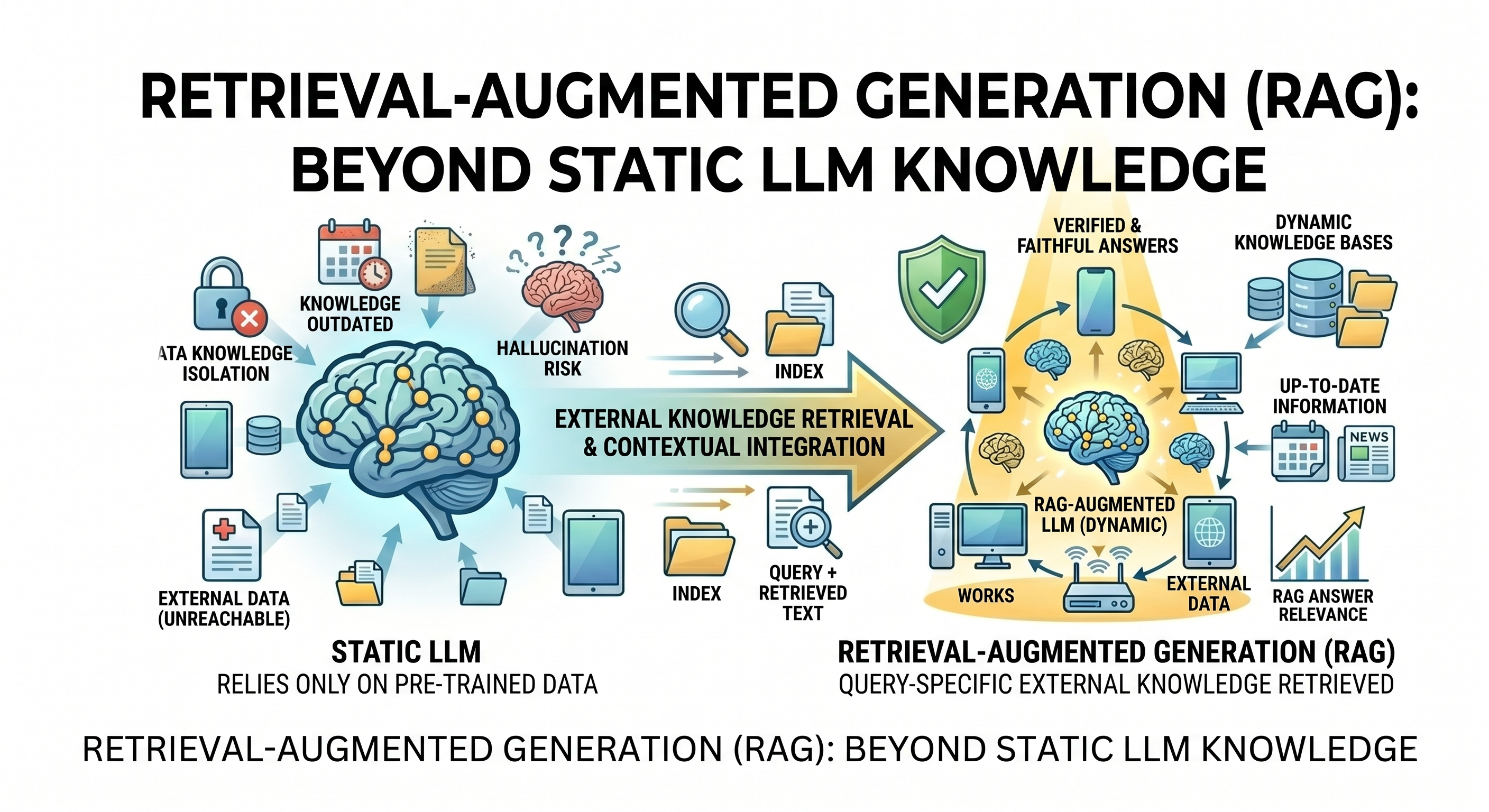
Large Language Models are powerful, but they suffer from a major limitation: their knowledge is frozen at training time. Retrieval-Augmented Generation (RAG) solves this by combining LLMs with external knowledge retrieval systems, enabling AI applications to access fresh, domain-specific information in real time.
What is RAG?
RAG systems work by retrieving relevant documents from a knowledge base before generating a response. Instead of relying entirely on parametric memory, the model grounds its answers in retrieved context.
Core Components of a RAG Pipeline
- Embedding Model: Converts documents into vector representations.
- Vector Database: Stores embeddings for semantic retrieval.
- Retriever: Finds relevant chunks based on similarity search.
- LLM Generator: Produces grounded responses using retrieved context.
Why RAG is Important
RAG dramatically improves factual accuracy, reduces hallucinations, and enables organizations to build private AI systems using proprietary data.
LangChain RAG Example
from langchain_openai import ChatOpenAI
from langchain_community.vectorstores import FAISS
from langchain_openai import OpenAIEmbeddings
from langchain.text_splitter import RecursiveCharacterTextSplitter
from langchain.chains import RetrievalQA

# Load documents
documents = [
    "Machine learning is transforming healthcare.",
    "Deep learning enables powerful image recognition.",
    "RAG systems combine retrieval with generation."
]

# Split text
splitter = RecursiveCharacterTextSplitter(
    chunk_size=100,
    chunk_overlap=20
)

docs = splitter.create_documents(documents)

# Create embeddings
embeddings = OpenAIEmbeddings()

# Build vector database
vectorstore = FAISS.from_documents(docs, embeddings)

# Create retriever
retriever = vectorstore.as_retriever()

# Initialize LLM
llm = ChatOpenAI(model="gpt-4o-mini")

# Build QA chain
qa_chain = RetrievalQA.from_chain_type(
    llm=llm,
    retriever=retriever
)

# Ask a question
query = "What are RAG systems?"

response = qa_chain.run(query)

print(response)
Challenges in RAG Systems
- Chunking Strategy: Poor chunking reduces retrieval quality.
- Embedding Drift: Embeddings may become outdated over time.
- Latency: Retrieval adds additional processing overhead.
- Context Limits: Retrieved content still must fit within the model context window.
The Rise of Enterprise RAG
In 2026, nearly every enterprise AI application integrates retrieval systems. From legal assistants to medical copilots, RAG has become the default architecture for trustworthy AI systems.
"The most powerful AI systems are no longer isolated models — they are connected intelligence systems grounded in real-world knowledge." - Ashish Gore