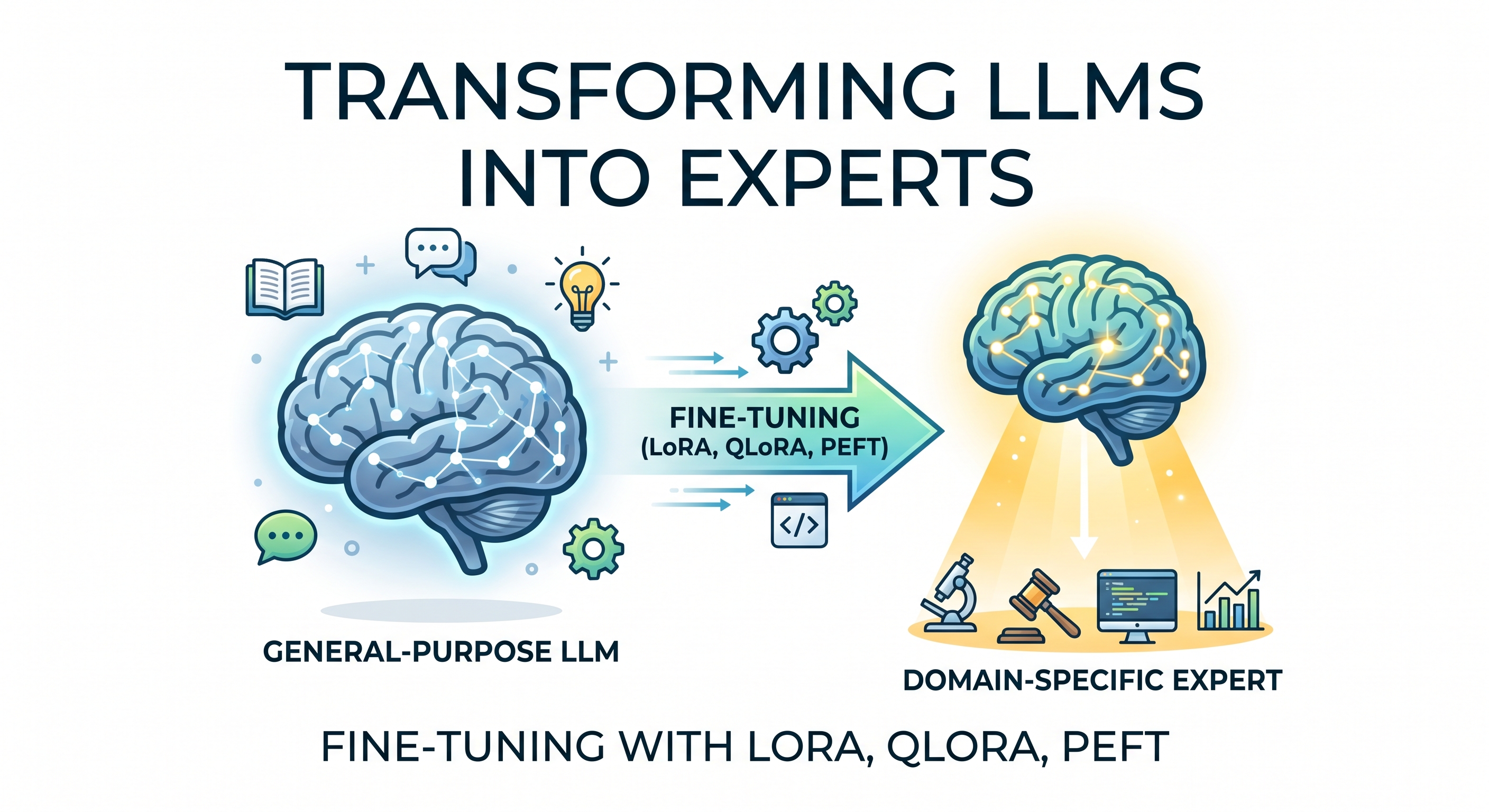
Pretrained Large Language Models like Meta's LLaMA 3, Mistral, and Google's Gemma are extraordinary starting points. They understand grammar, logic, reasoning, and world knowledge. But they are generalists. If you need a model that speaks in the precise tone of your brand, understands your industry's jargon, or follows a very specific output format reliably, general-purpose models often fall short. Fine-tuning is the process of continuing training on a curated dataset to adapt a model's behavior to your exact requirements — and modern techniques have made this accessible even on consumer hardware.
Full Fine-Tuning vs. Parameter-Efficient Fine-Tuning (PEFT)
Traditionally, fine-tuning meant updating all the billions of parameters in a model. This is called full fine-tuning, and while effective, it requires enormous GPU memory and risks catastrophic forgetting — where the model loses its general capabilities while specializing. A 7-billion-parameter model requires roughly 28 GB of VRAM just to store the weights in fp16, before accounting for gradients and optimizer states.
Parameter-Efficient Fine-Tuning (PEFT) methods solve this by only training a small fraction of the parameters, leaving the original model weights frozen. The most popular PEFT method today is LoRA (Low-Rank Adaptation), which injects small, trainable matrices alongside the frozen weight matrices. Because only these adapters are trained, memory usage drops dramatically and the risk of catastrophic forgetting is minimized.
QLoRA: Fine-Tuning on a Consumer GPU
QLoRA (Quantized LoRA), introduced in 2023, pushed the boundaries even further. It quantizes the base model weights to 4-bit precision (using NF4 quantization), loads the frozen quantized model, and then applies LoRA adapters in full 16-bit precision on top. The result is astonishing: you can fine-tune a 7B parameter model on a single 16 GB GPU, or even a 13B model on a 24 GB consumer card. This democratized fine-tuning for individual researchers and small teams.
Choosing Your Training Data
The quality and format of your fine-tuning dataset matters enormously — far more than quantity. For instruction-following tasks, data is typically formatted as instruction-response pairs in a standardized chat template (such as Alpaca or ChatML format). Key principles for dataset curation include:
- Quality over quantity: 1,000 high-quality, diverse examples often outperform 100,000 noisy ones.
- Format consistency: Always use the same prompt template your model expects — mixing formats confuses the model.
- Task diversity: Include varied examples of every sub-task you want the model to handle.
- Avoid data leakage: Keep your test set completely separate from training data to evaluate generalization honestly.
A Practical Code Example with Hugging Face and TRL
The following example uses the Hugging Face transformers, peft, and trl libraries to fine-tune a small model with QLoRA. This is the same stack used in production by many ML teams today.
# Fine-tuning a LLM with QLoRA using Hugging Face TRL
import torch
from datasets import load_dataset
from transformers import AutoModelForCausalLM, AutoTokenizer, BitsAndBytesConfig
from peft import LoraConfig, get_peft_model, TaskType
from trl import SFTTrainer, SFTConfig

MODEL_NAME = "meta-llama/Meta-Llama-3-8B-Instruct"

# ── Step 1: Configure 4-bit quantization (QLoRA) ──────────────────
bnb_config = BitsAndBytesConfig(
    load_in_4bit=True,
    bnb_4bit_use_double_quant=True,
    bnb_4bit_quant_type="nf4",       # NormalFloat4 for best quality
    bnb_4bit_compute_dtype=torch.bfloat16
)

# ── Step 2: Load the base model and tokenizer ─────────────────────
model = AutoModelForCausalLM.from_pretrained(
    MODEL_NAME,
    quantization_config=bnb_config,
    device_map="auto"
)
tokenizer = AutoTokenizer.from_pretrained(MODEL_NAME)
tokenizer.pad_token = tokenizer.eos_token

# ── Step 3: Configure the LoRA adapter ───────────────────────────
lora_config = LoraConfig(
    task_type=TaskType.CAUSAL_LM,
    r=16,                    # Rank of the adapter matrices
    lora_alpha=32,           # Scaling factor
    target_modules=["q_proj", "v_proj", "k_proj", "o_proj"],
    lora_dropout=0.05,
    bias="none"
)
model = get_peft_model(model, lora_config)
model.print_trainable_parameters()
# Output: trainable params: 20,971,520 || all params: 8,051,232,768 || trainable%: 0.26%

# ── Step 4: Load and prepare your dataset ────────────────────────
dataset = load_dataset("json", data_files="my_instruction_dataset.jsonl", split="train")

def format_prompt(example):
    return {"text": f"### Instruction:\n{example['instruction']}\n\n### Response:\n{example['output']}"}

dataset = dataset.map(format_prompt)

# ── Step 5: Train with SFTTrainer ─────────────────────────────────
training_args = SFTConfig(
    output_dir="./finetuned-llama3",
    num_train_epochs=3,
    per_device_train_batch_size=4,
    gradient_accumulation_steps=4,
    learning_rate=2e-4,
    fp16=True,
    logging_steps=25,
    save_steps=200,
    dataset_text_field="text",
    max_seq_length=1024,
)

trainer = SFTTrainer(
    model=model,
    train_dataset=dataset,
    args=training_args,
    tokenizer=tokenizer,
)

trainer.train()
trainer.save_model("./finetuned-llama3-final")
print("Fine-tuning complete. Adapter weights saved.")
Evaluating Your Fine-Tuned Model
Fine-tuning without rigorous evaluation is incomplete. Common evaluation strategies include using benchmark datasets specific to your domain, human preference evaluation (where annotators compare base model vs. fine-tuned outputs), and automated metrics. For instruction-following tasks, frameworks like LLM-as-a-Judge — where a strong model like GPT-4 evaluates the outputs of your fine-tuned model — have become popular due to their scalability. Always compare against a baseline and watch carefully for regressions in general capability.
Fine-Tuning vs. RAG: Choosing the Right Tool
A common question in AI development is when to fine-tune versus when to use RAG. The short answer: use RAG for knowledge, use fine-tuning for behavior. If you need the model to know specific facts, dates, or documents, RAG is more appropriate and easier to update. If you need to change how the model responds — its tone, output format, reasoning style, or adherence to domain-specific constraints — fine-tuning is the right lever. The most powerful production systems often combine both approaches.
Conclusion
Modern PEFT techniques like LoRA and QLoRA have transformed fine-tuning from an enterprise-only privilege into something any developer with a laptop-class GPU can accomplish. With the right dataset, the right configuration, and careful evaluation, you can take a state-of-the-art open-source model and mold it into a specialized assistant that outperforms much larger general-purpose models on your specific task. This is one of the most powerful skills an AI developer can possess today.
"Fine-tuning is not about teaching a model more facts — it's about teaching it who to be. Character is shaped by experience, and a model's character is shaped by its training data." - Ashish Gore
Have questions about building a fine-tuning pipeline for your use case? Feel free to reach out through my contact information.