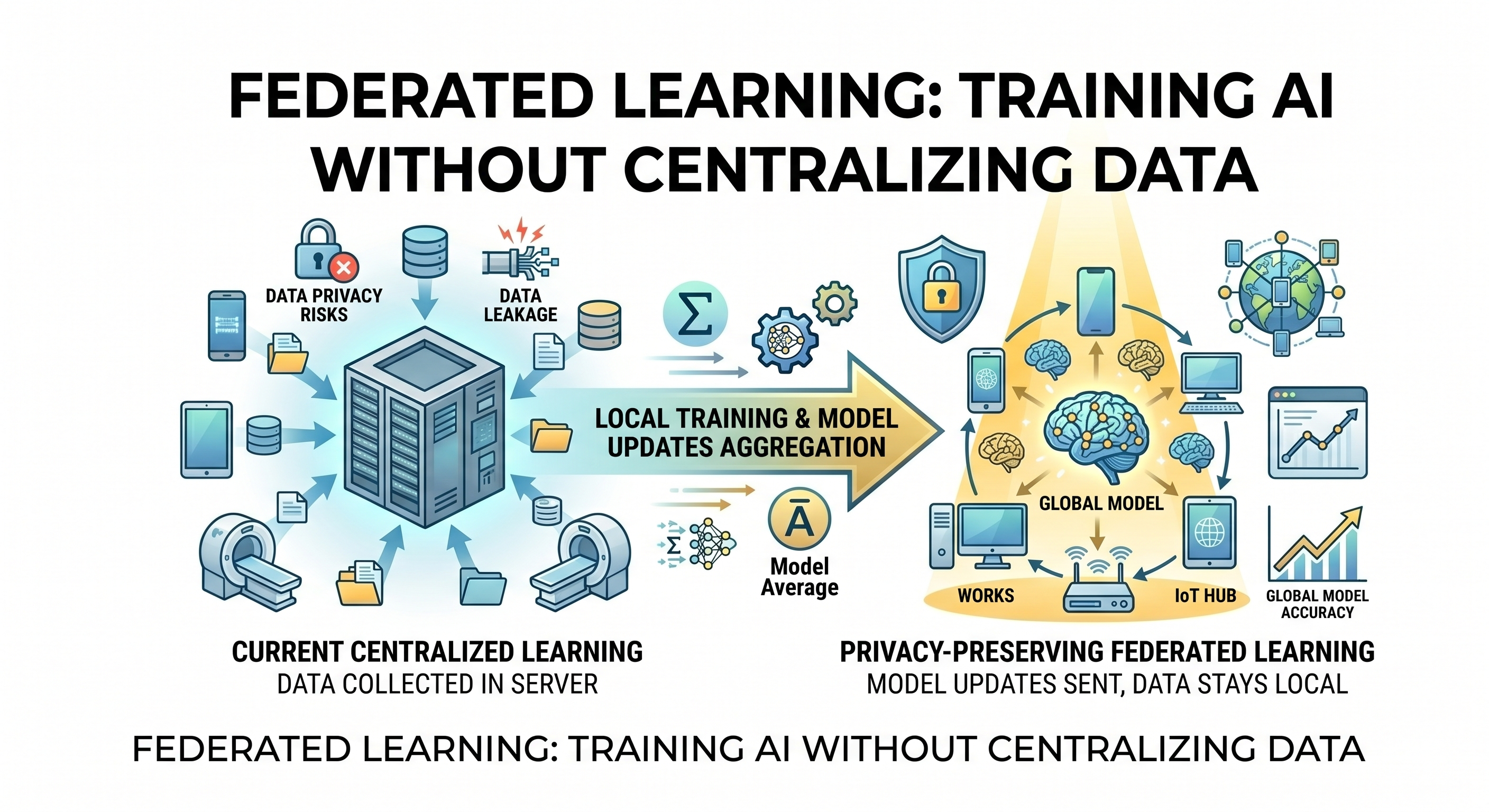
Modern AI systems are hungry for data, but collecting and centralizing user information introduces enormous privacy, legal, and security concerns. Federated Learning changes this paradigm by allowing machine learning models to train directly on distributed devices without moving raw data to a central server. Instead of sending personal data to the cloud, devices train locally and only share model updates.
Why Federated Learning Matters
Traditional machine learning pipelines depend on centralized datasets. While effective, this approach creates major risks:
- Privacy Concerns: Sensitive user data can be exposed during collection or storage.
- Regulatory Challenges: Laws like GDPR restrict how personal data can be processed.
- Bandwidth Costs: Uploading massive datasets from millions of devices is expensive.
- Security Risks: Centralized data repositories become high-value attack targets.
Federated learning addresses these issues by keeping user data local while still enabling global model improvements.
How Federated Learning Works
The federated learning workflow generally follows these steps:
- A global model is initialized on the server.
- The model is sent to participating devices.
- Each device trains locally using its private data.
- Only model gradients or weight updates are sent back.
- The server aggregates updates into a new global model.
This process repeats continuously, allowing the model to improve collectively while preserving privacy.
Applications in the Real World
Federated learning is already used across multiple industries:
- Smartphones: Predictive keyboards improve suggestions without uploading user conversations.
- Healthcare: Hospitals collaboratively train diagnostic AI models without sharing patient records.
- Finance: Banks detect fraud patterns while keeping transaction data internal.
- IoT Devices: Smart home devices adapt locally without exposing behavioral data.
TensorFlow Federated Example
# Simple Federated Learning Workflow using TensorFlow Federated

import tensorflow as tf
import tensorflow_federated as tff

# Load and preprocess EMNIST dataset
emnist_train, _ = tff.simulation.datasets.emnist.load_data()

def preprocess(dataset):
    def batch_format_fn(element):
        return (
            tf.reshape(element['pixels'], [-1, 784]),
            tf.reshape(element['label'], [-1, 1])
        )

    return dataset.repeat(1).batch(20).map(batch_format_fn)

# Create model
def create_keras_model():
    return tf.keras.models.Sequential([
        tf.keras.layers.Input(shape=(784,)),
        tf.keras.layers.Dense(128, activation='relu'),
        tf.keras.layers.Dense(10, activation='softmax')
    ])

# Define model function
def model_fn():
    keras_model = create_keras_model()

    return tff.learning.models.from_keras_model(
        keras_model,
        input_spec=preprocess(
            emnist_train.create_tf_dataset_for_client(
                emnist_train.client_ids[0]
            )
        ).element_spec,
        loss=tf.keras.losses.SparseCategoricalCrossentropy(),
        metrics=[tf.keras.metrics.SparseCategoricalAccuracy()]
    )

# Federated averaging process
trainer = tff.learning.algorithms.build_weighted_fed_avg(
    model_fn
)

# Prepare federated data
federated_train_data = [
    preprocess(
        emnist_train.create_tf_dataset_for_client(client)
    )
    for client in emnist_train.client_ids[:3]
]

# Initialize training
state = trainer.initialize()

# Train for multiple rounds
for round_num in range(1, 6):
    result = trainer.next(state, federated_train_data)
    state = result.state

    print(f"Round {round_num} completed")
Challenges in Federated Learning
- Communication Overhead: Millions of devices continuously sending updates creates network strain.
- Device Heterogeneity: Different hardware capabilities impact training consistency.
- Non-IID Data: User data distributions vary significantly across devices.
- Model Poisoning: Malicious devices can intentionally send harmful updates.
The Future of Privacy-Preserving AI
As AI systems become more integrated into daily life, privacy-preserving techniques will become essential. Federated learning represents one of the strongest alternatives to centralized data collection and aligns perfectly with the future direction of edge AI and decentralized intelligence.
"The future of AI is not just about smarter models — it is about building intelligence that respects privacy by design." - Ashish Gore