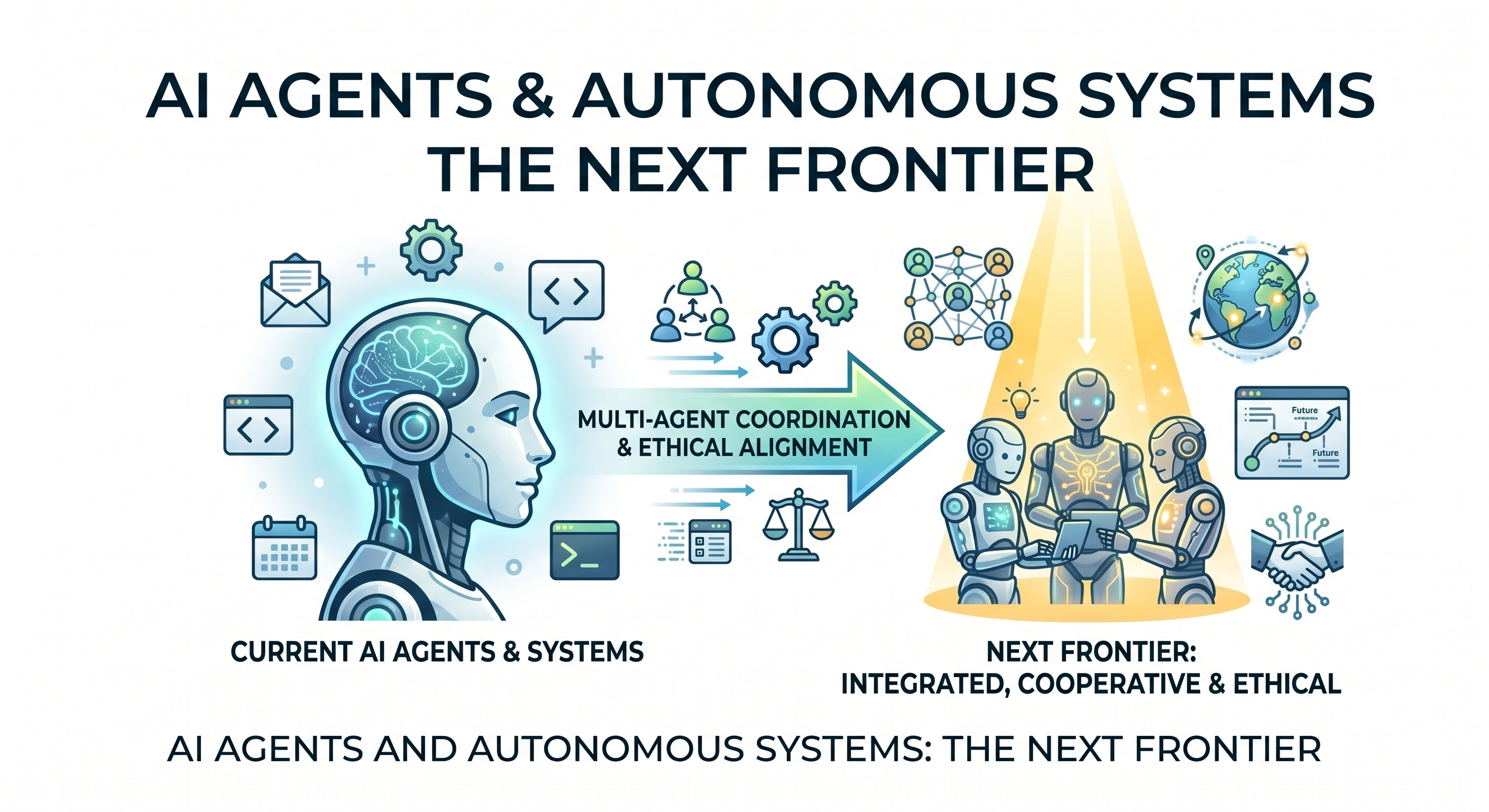
For most of their existence, language models have been reactive: you send a message, they reply. This is powerful, but it fundamentally limits what AI can accomplish to tasks that fit within a single turn. AI Agents represent the next paradigm shift — LLMs that can autonomously plan, reason across multiple steps, use external tools, and execute complex workflows to achieve goals that no single prompt could accomplish. In 2026, agentic AI is no longer a research curiosity; it is rapidly becoming the dominant mode of deploying AI in production.
What Makes an Agent an Agent?
An AI agent is distinguished from a standard LLM chatbot by four core capabilities:
- Planning: The ability to decompose a complex goal into a sequence of sub-tasks and decide which to tackle in what order.
- Tool Use: Access to external tools — web search, code execution, APIs, databases, file systems — that extend the model's capabilities beyond what is in its context window.
- Memory: The ability to store and retrieve information across steps. This can be in-context (the conversation history), external (a vector database), or a structured state object.
- Self-Reflection and Correction: The ability to evaluate its own outputs, recognize when something went wrong, and try a different approach — often called a "ReAct" loop.
The ReAct Framework: Think, Act, Observe
ReAct (Reasoning + Acting), introduced in a 2022 paper from Google, is the foundational pattern for LLM agents. The model operates in an iterative loop: it first generates a thought (internal reasoning about what to do next), then selects an action (calling a tool with specific inputs), and finally receives and processes an observation (the tool's output). This loop continues until the model determines it has enough information to produce a final answer. The key insight is that interleaving reasoning with action allows the model to correct its course based on real-world feedback rather than hallucinating its way through multi-step tasks.
Multi-Agent Systems
For the most complex tasks, a single agent is often insufficient. Multi-agent architectures coordinate multiple specialized agents, each responsible for a sub-domain. A common pattern is an orchestrator-worker model: a central "planner" agent breaks a task into sub-goals and delegates each to a specialized worker agent (a "researcher," a "coder," a "writer"). Frameworks like LangGraph, AutoGen, and CrewAI have emerged to make building these systems tractable by managing agent communication, shared state, and execution flow as an explicit directed graph.
A Practical Code Example with LangGraph
LangGraph, built on LangChain, represents agent workflows as nodes (LLM calls or tool executions) and edges (transitions determined by the model's output) in a directed acyclic graph. This makes complex, branching agent logic debuggable and composable.
# Building a ReAct agent with LangGraph and tool use
from langchain_openai import ChatOpenAI
from langchain_community.tools import DuckDuckGoSearchRun, PythonREPLTool
from langchain.agents import create_react_agent
from langchain import hub
from langgraph.prebuilt import create_react_agent as langgraph_create_agent

# ── Step 1: Define the tools the agent can use ────────────────────
tools = [
    DuckDuckGoSearchRun(),    # Web search capability
    PythonREPLTool(),         # Code execution capability
]

# ── Step 2: Initialize the LLM ────────────────────────────────────
llm = ChatOpenAI(model="gpt-4o", temperature=0)

# ── Step 3: Create the agent with LangGraph (automatic ReAct loop) ─
agent = langgraph_create_agent(llm, tools)

# ── Step 4: Invoke the agent with a multi-step task ───────────────
task = """
Find the current population of the top 3 most populous countries,
calculate what percentage of total world population they represent
combined, then display the result as a formatted summary.
"""

config = {"recursion_limit": 10}  # Safety: max 10 ReAct iterations

response = agent.invoke(
    {"messages": [("human", task)]},
    config=config
)

# ── Step 5: Extract and display the final answer ──────────────────
final_message = response["messages"][-1]
print("=== Agent Final Answer ===")
print(final_message.content)

# The agent will autonomously:
# 1. THINK: "I need to search for the population of the top 3 countries"
# 2. ACT: Call DuckDuckGoSearchRun("most populous countries 2026")
# 3. OBSERVE: Get search results
# 4. THINK: "Now I have the data, let me compute the percentages in Python"
# 5. ACT: Call PythonREPLTool with calculation code
# 6. OBSERVE: Get computed result
# 7. THINK: "I have everything I need to format the final answer"
# 8. RESPOND: Generate the formatted summary
Key Challenges in Agentic Systems
Building reliable agents is significantly harder than building a simple chatbot. Several challenges require careful engineering:
- Error Propagation: In a multi-step pipeline, errors compound. A bad assumption at step 2 can cause all subsequent steps to fail silently or incorrectly. Robust error handling and retry logic are essential.
- Context Window Management: Long agent traces fill up the context window quickly. Techniques like summarization, sliding windows, and extractive memory are needed for long-running agents.
- Tool Design: The quality of an agent is often limited by the quality of its tools. Poorly described or unreliable tools lead to an unreliable agent. Clear tool descriptions and schemas are as important as the LLM choice.
- Human-in-the-Loop: For high-stakes actions (sending emails, executing database writes, making purchases), agents should pause and request human confirmation before proceeding. LangGraph's interrupt mechanism supports this natively.
Conclusion
AI agents mark a fundamental transition in how we use AI — from tools that answer questions to systems that independently get things done. As LLMs become more capable and frameworks more mature, the line between "AI assistant" and "AI colleague" will continue to blur. For developers, understanding how to architect, build, and safely deploy agentic systems is becoming one of the most valuable and in-demand skills in the industry.
"The next major milestone in AI is not a smarter model — it is a more autonomous one. The shift from answering to acting changes everything about how we build software." - Ashish Gore
Looking to automate complex workflows with AI agents? Let's explore the possibilities — connect through my contact information.