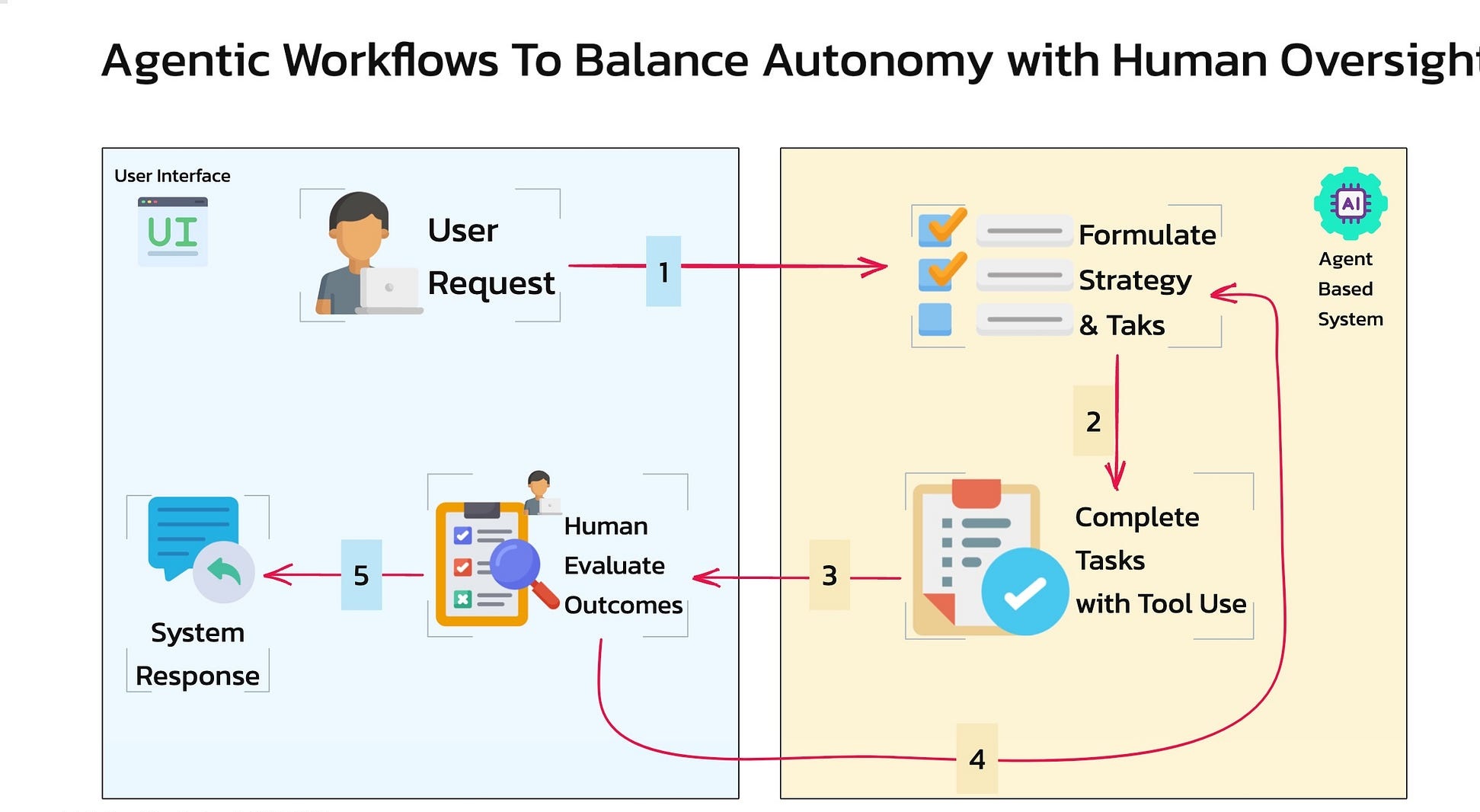
The rise of large language models (LLMs) has given birth to a new paradigm: agentic workflows. Unlike traditional automation where scripts execute predefined tasks, agentic systems combine reasoning, memory, and autonomy. These AI agents can plan, collaborate, and adapt dynamically, working alongside humans. In this post, I’ll explore what agentic workflows are, how they work, real-world applications, and the challenges that come with them.
What are agentic workflows?
Agentic workflows are processes where AI systems act as autonomous agents, capable of perceiving context, reasoning about goals, and taking actions — often in collaboration with humans or other agents. Instead of being hard-coded, they adapt to new information and changing requirements.
Key components of agentic systems
- Planning. Breaking down high-level goals into actionable steps.
- Reasoning. Choosing the best path forward using contextual understanding.
- Tools & APIs. Agents connect with external systems to execute tasks.
- Memory. Storing past interactions to inform future actions.
- Collaboration. Working with humans or multiple agents to complete workflows.
Frameworks enabling agentic workflows
Several open-source and commercial frameworks are making agentic workflows more accessible:
- LangChain. For chaining LLM reasoning with external tools.
- LangGraph. A graph-based framework for building structured agent workflows.
- AutoGPT & BabyAGI. Early experiments in autonomous goal-driven agents.
- Vext Agents. Applied platforms enabling agent workflows in production systems.
Hands-on example: a simple research assistant agent
from langchain.agents import initialize_agent, load_tools
from langchain.llms import OpenAI

tools = load_tools(["serpapi", "python"])
llm = OpenAI(temperature=0)

agent = initialize_agent(tools, llm, agent="zero-shot-react-description", verbose=True)
response = agent.run("Find the latest RBI guidelines on digital lending and summarize them.")

print(response)
This agent searches the web, processes the information, and generates a summary — a workflow that would normally take a human analyst hours.
Applications of agentic workflows
- Finance. Agents assisting with compliance checks, report generation, and fraud monitoring.
- Healthcare. Patient triage assistants that integrate speech, vision, and medical databases.
- Customer service. AI agents that escalate cases, draft responses, and provide real-time insights to support teams.
- Research. Multi-agent systems that divide tasks (e.g., one summarizes papers, another generates experiments).
Human-AI collaboration
Agentic workflows are not about replacing humans but augmenting them. A credit analyst, for example, may work with an AI agent that pre-fills risk assessments, while the human focuses on judgment calls. The synergy lies in combining machine efficiency with human expertise.
Challenges of agentic systems
- Reliability. Agents can hallucinate or make incorrect assumptions.
- Security. Autonomy increases the risk of unintended actions if not controlled.
- Coordination. Multi-agent systems may conflict without well-defined protocols.
- Ethics & compliance. Delegating sensitive tasks to autonomous agents raises regulatory questions.
The future of agentic workflows
The trajectory is clear: workflows will increasingly involve a mix of humans and AI agents. Future systems may have agents specialized by role (e.g., compliance agent, research agent, reporting agent), working under human supervision. Advances in orchestration frameworks like LangGraph are pushing us toward scalable, safe agent ecosystems.
Conclusion
Agentic workflows represent a paradigm shift in human-AI collaboration. By combining autonomy, reasoning, and adaptability, they open new frontiers for productivity. The challenge lies in ensuring reliability, governance, and trust. Those who master agentic workflows will unlock a powerful competitive advantage in the age of AI.
"The future of work is not human or AI — it is human with AI." – Ashish Gore
If you’re interested, I can create a dedicated follow-up on building multi-agent systems with LangGraph, showcasing practical workflows for compliance and analytics.